You're not the only one
who noticed.
and you were allowed to look closer
One piece of rigorous, sourced scholarship a week — on the translations, doctrines, and history nobody handed you the first time. No pressure, no pitch. Just the sources.
"I finally had language for what I'd been feeling for years."
— Reader, First 90 Days Out
"It's the first thing that treated my questions as reasonable."
— Reader, Unbound
Someone sat down
with the lexicon open.
obody translated arsenokoitai as "homosexual" until 1946. The word had been sitting there in Greek for roughly 1,900 years, apparently content to mean something else. The translators who made that choice later said they weren't certain about it. That's a hundred-year-old decision most people have inherited as if it came from Sinai.
What They Skipped was founded by a trans man with over ten years of Bible study leadership and graduate-level research training. Not a linguist. A rigorous student of the scholarship, working from published scholars, lexicons, and translation records, and citing every claim.
The skill here is making that scholarship usable for the people who actually need it. Not the seminary graduates who already have access to the lexicons. The person reading at midnight who can't stop asking a question they were told they shouldn't have. The one who noticed something was off years ago and needs to know whether they were right. That person deserves careful, sourced work just as much as anyone else. Arguably more.
Where scholars split, this work says so. Where a claim can't be sourced, it gets cut. One overstated sentence costs the reader everything. This audience, burned by overstatement before, will notice immediately and never come back. They've read the other books. They highlighted them. They wrote furious notes in the margins. That's actually where the name came from.

What They Skipped: biblical scholarship for the people who needed it most
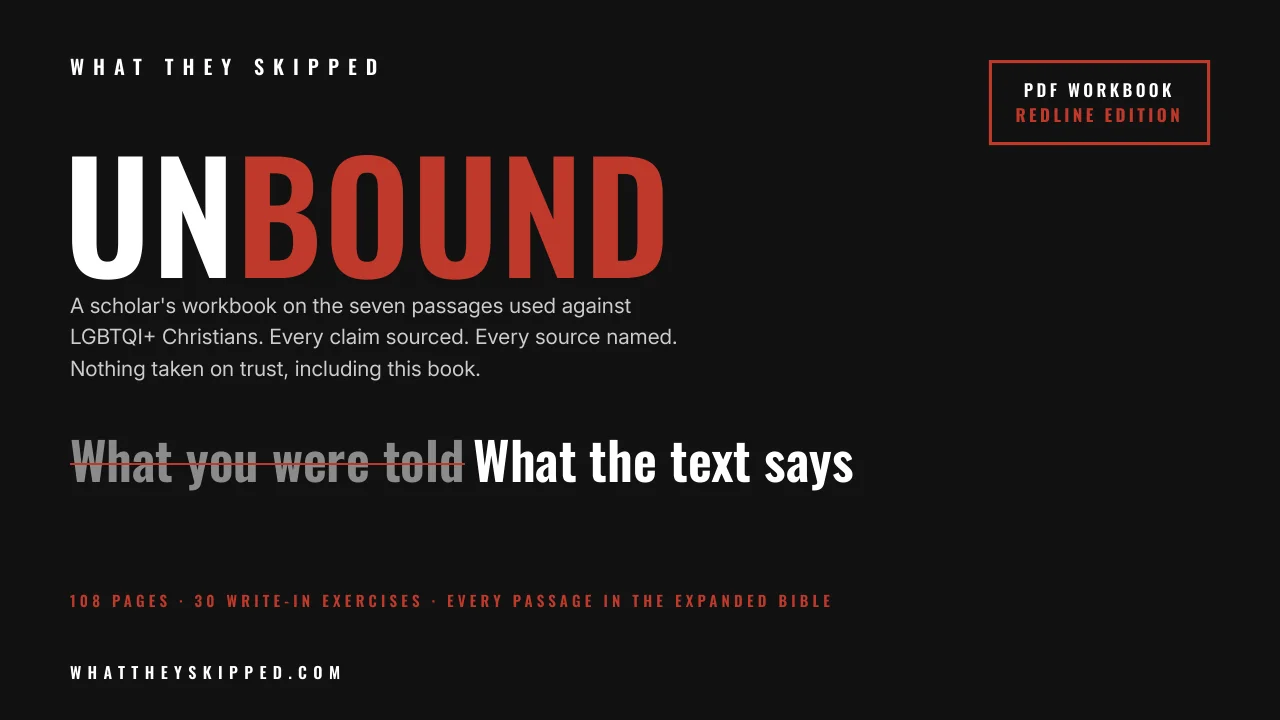
Unbound
A Scholar's Guide to the 7 Passages Used Against LGBTQ+ Christians
Seven passages. Each one with a word study, historical context, translation history, and honest interpretation, sourced throughout. The Hebrew and Greek do things that most English translations don't show you.
This guide covers Genesis 19, Leviticus 18 and 20, Romans 1, 1 Corinthians 6, 1 Timothy 1, Jude 7, and Genesis 1–2. The to'evah question. The arsenokoitai question. The Sodom question. All of them, carefully.
People buy it for themselves, for a parent who sent them an article, for a pastor who quoted a verse without looking it up, and occasionally to settle a group-chat argument that has been going for three years. All valid use cases.
Seven passages examined:
- Genesis 19 & Sodom: what the text actually condemns
- Leviticus 18 & 20: to'evah, ritual purity, and context
- Romans 1: honor/shame culture and the argument's structure
- 1 Corinthians 6 & 1 Timothy 1: the 1946 translation decision
- Jude 7: "strange flesh" and what scholars actually say
- Genesis 1–2: what "male and female" does and doesn't establish
PDF delivered to your inbox instantly. Often gifted. Always sourced. Occasionally read in a church parking lot before going inside.
$19
First 90 Days Out
A Workbook for the Space Between
The first three months after leaving evangelical faith are a specific kind of chaos. This workbook walks through it in three phases: the immediate aftermath, rebuilding what you actually believe, and figuring out what comes next. Write-line prompts, sourced frameworks, no toxic positivity.
Coming soon · $19$27
What They Actually Taught You
A Scholar's Guide to 10 Evangelical Doctrines
Ten doctrines — inerrancy, penal substitution, gender complementarianism, and seven more — examined for what they actually say, where they came from, and what scholars outside evangelical publishing have said about them. Tables, sourced history, and room to think.
Coming soon · $27The word translated "abomination" in Leviticus is to'evah. It shows up for shellfish, for mixed fabrics, for charging interest. It marks ritual impurity, not moral horror. That distinction does a lot of work.
There's a lot more ground to cover.
Each guide is built the same way: sourced, careful, and honest about where the evidence actually lands. As it happens, the version of Christianity most people were taught turns out to have been selectively edited (which, to be fair, took quite a lot of effort over quite a lot of centuries). There's no shortage of material.
First Year Out
Longer-term reconstruction. Identity, community, what belief looks like now.
Finding Community Outside Faith
The loneliness question. What to do when the community was the church.
Deconstructing Evangelicalism
The history, the politics, the theology: where it came from and what it costs.
What You Didn't Learn in Sunday School
The church history, the manuscript gaps, the ANE context that never made it into the pews.
Ancient Near East Mistranslations That Change Everything
The words that got carried across centuries with the wrong meaning attached.
The Rapture Isn't in the Bible (Like That)
John Nelson Darby invented it in the 1830s. A Scottish teenager's vision helped spread it. It became the backbone of American evangelical eschatology. The text does not cooperate with this.
Hell: A History
Sheol. Gehenna. Tartarus. Eternal conscious torment. These are not the same thing. The journey from the Old Testament underworld to modern hell is a long, strange trip through Second Temple Judaism, Greek philosophy, and medieval imagery.
Who Decided What's in the Bible?
The canon wasn't handed down complete. It was debated, disputed, and voted on over several centuries. Some books that almost made it in are fascinating. Some that did make it are worth a closer look.
Purity Culture: Origin Story
Where it came from, how quickly it spread, what it cost people, and why the theology was always shakier than the marketing suggested.
"Let Women Be Silent": A Textual Problem
1 Corinthians 14:34–35 may not have been in the original letter. Many scholars think it was a margin note that got copied into the text. This is the kind of thing that changes the conversation somewhat.
"Biblical Marriage": What the Bible Actually Depicts
Polygamy. Concubinage. Levirate marriage. Wives acquired as war spoils. The Bible describes a lot of things. Whether it prescribes them is a different question. The answer is more complicated than the bumper sticker implies.
Complementarianism: A Very Recent Invention
The formal theological framework for male headship was largely constructed in the 1980s, in response to the feminist movement, not from two thousand years of unified tradition. The Council on Biblical Manhood and Womanhood was founded in 1987. The Danvers Statement is from 1987. Worth knowing.
How the Bible Was Used to Defend Slavery
The hermeneutics that justified chattel slavery in America are worth understanding. Not because it's comfortable, but because they reveal how the same interpretive moves get made again and again for different purposes. The pattern matters.
New guides are released when they're actually finished and properly sourced. Which is more often than you'd think. Get on the list.
The Abomination Question
What Leviticus 18:22 actually says — and what got lost in translation.
- What toevah means in Hebrew (and what it doesn't)
- The 116 other things also called toevah in the Old Testament
- The Hebrew word for moral evil — and why Leviticus doesn't use it here
- Named scholars. Full citations. Hostile-reader standard.
One passage. Fully unpacked. A preview of what the full guide covers for all seven.
Get the free guide
The scholarship,
in your inbox.
One piece of rigorous, sourced scholarship per week. Translation history. Word studies. The historical context that changes how a passage reads. Free, always cited, no pitch at the top.
- Named scholars, not anonymous summaries
- No culture-war framing, no political hot takes
- Unsubscribe any time, no questions
Common questions
Who is What They Skipped written for?
Anyone who has ever suspected they were handed an edited version of the text and wants to know what was left out. That could mean you're mid-deconstruction, freshly out, LGBTQ+, questioning, exvangelical, or you're just someone who reads footnotes and gets annoyed when the citation doesn't hold up. You don't have to be in crisis. You don't have to be leaving anything. Curiosity is genuinely enough.
What if I'm still a Christian but I have questions?
Then you're in good company — most of church history was also Christians with questions. These guides don't ask you to leave anything. They give you the actual scholarship so you can think for yourself, which has traditionally been considered a virtue. What you do with it is entirely yours.
What if I'm not deconstructing — I'm just curious?
Excellent. These guides are for anyone who wants the full picture, not just the approved version. You don't need a crisis. You just need to actually want to know what's in the text — and what isn't. Some of our most enthusiastic readers are just people who find this genuinely interesting, which, fair.
What is First 90 Days Out?
A practical guide for the first weeks after you stop — or start to stop — or aren't sure yet if you're stopping. What to do with your Sundays, your relationships, your 2am questions, and the strange relief nobody warned you about. Clearly structured, because some people really need that and there's nothing wrong with it. Not a theology book. A map for a disorienting stretch of time. $19 PDF, delivered instantly.
What is Unbound?
Unbound: A Scholar's Guide to the 7 Passages Used Against LGBTQ+ Christians is a $27 PDF covering Genesis 19, Leviticus 18 and 20, Romans 1, 1 Corinthians 6, 1 Timothy 1, Jude 7, and Genesis 1–2. Each passage gets word study, historical context, translation history, and careful interpretation, sourced throughout, no claim without a citation. People buy it for themselves, for a parent who sent them a Bible verse in a text, for a pastor, or to settle a group chat argument that's been running since 2019.
Is this scholarship or advocacy?
Scholarship. When you follow the sources where they lead, the sources tend to be interesting about it. Every linguistic and historical claim cites published scholars, lexicons, or translation records. Where scholars disagree, the guide says so — clearly, with both positions represented. No claim is made that can't be sourced. The goal is accuracy, not a conclusion. It just turns out the accurate version is considerably more interesting than what most people were taught.
Who wrote these guides?
What They Skipped was founded by a trans man with over ten years of Bible study leadership and graduate-level research training. Not a linguist — a rigorous student of published scholarship, working from scholars, lexicons, and translation history, and citing every source. He did not set out to write about this. The scholarship made it extremely difficult to stop. (He also needed this himself, which helps, and is perhaps the most important credential of all.)
I'm neurodivergent and I need clear structure. Is this that?
Yes, deliberately. Each guide is organized systematically — clear sections, clearly labeled, no burying the point in paragraph seven. The scholarship is rigorous but the presentation is designed for actual humans, not just academics. If you've ever wished someone would just tell you what the argument is, what the sources say, and what it means — that's exactly what these are. No assumed prior knowledge. No skipping steps.
What format are the guides delivered in?
PDF, to your inbox, instantly after purchase. No account required. No app. No subscription that you'll forget to cancel. Read on your phone at 2am, print it out and annotate it aggressively, highlight it and send photos to your friends — whatever helps. Nobody is watching. That's rather the point.